
National Emergency in India (1975): A Dark Chapter in Democracy
Explore the National Emergency in India (1975), a turning point in Indian democracy. Learn about its causes, impacts on rights, and how it reshaped India’s political landscape.
1/14/20254 min read
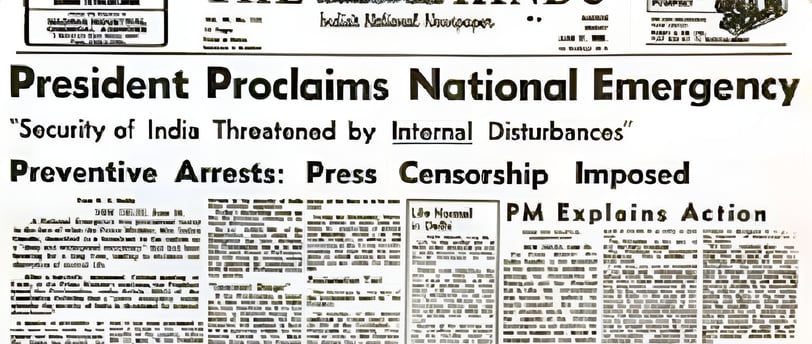
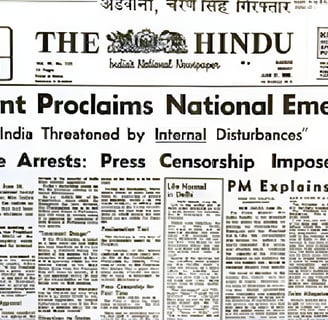
The National Emergency in India (1975) is one of the most controversial events in the country’s history. Declared by our former prime Minister Indira Gandhi, it marked a dark period where democracy was suspended, and fundamental rights were restricted. In this blog, we explore the causes, consequences, and hidden stories of the 1975 Emergency that changed India’s political and social landscape forever.
What is a National Emergency, and when should a country declare it?
A National Emergency is a situation where a country faces a major threat to its security. A National Emergency can be declared during war or internal conflicts, such as armed rebellion, allowing the government to take special actions to protect the nation and restore order.
Incidents Leading to the Declaration of the 1975 National Emergency in India
In the 1971 Lok Sabha elections, the Congress Party secured a majority(352/521) win, and Indira Gandhi was elected as Prime Minister. She contested the election from Rae Bareli in Uttar Pradesh, defeating Raj Narain. However, a case was filed against her by Raj Narain in Allahabad high court, alleging 14 instances of fraud in the election. While 12 of the allegations were dismissed, the court accepted two. As a result, on 12 June 1975 the court disqualified Indira Gandhi from holding any elected position for six years and ordered her to resign, with a new Prime Minister to be elected within 20 days. Indira Gandhi appealed the decision to the Supreme Court, which upheld the High Court's ruling but allowed her to remain as Prime Minister until the next hearing.
The Day: June 25, 1975 - A Turning Point in Indian History
Jaiprakash Narayan and Morarji Desai organized anti-government protests in Delhi, which Indira Gandhi portrayed as an armed rebellion. Indira Gandhi persuaded President Fakhruddin Ali Ahmed to declare a National Emergency, doing so without consulting the Union Cabinet. This marked the first time an emergency was declared due to internal rebellion, unlike in 1962 and 1971 when emergencies were declared in response to war and external aggression. Shortly after the emergency was declared, electricity was cut off to the press and media to prevent the news from spreading. The public only learned about the declaration the next morning when Indira Gandhi made the announcement on the radio.
Within 24 hours, opposition leaders who spoke against the government, including Morarji Desai, Jai Prakash Narayan, L.K. Advani, and Charan Singh, were arrested, along with members of Indira Gandhi’s own party who opposed her. Over one lakh ordinary citizens were also jailed for criticizing the government.
During the two years of the Emergency, the fundamental rights of citizens were suppressed. The central government took control of states ruled by non-Congress parties, leading to widespread human rights violations. The police detained individuals without trial, and Indira Gandhi’s son, Sanjay Gandhi, exercised powers beyond the constitution. He carried out forced mass sterilizations as part of an effort to control India’s population. Indira Gandhi also made multiple amendments to the constitution, one of which made the office of the Prime Minister immune to legal challenges, effectively nullifying the case against her. The Emergency was finally lifted on March 21, 1977.
What Allegations Were Accepted by the Court Against Indira Gandhi?
Use of Government Machinery for Campaigning: Indira Gandhi was accused of utilizing government resources, including barricades and police force, to support her election campaign.
Using Government Officials for Election Campaigning: Yashpal Kapoor, a gazetted officer in the Prime Minister’s Secretariat, actively campaigned for Indira Gandhi in Uttar Pradesh's Munshiganj while still holding his government position.
What Happend after Emergency was lifted
In 1977, elections were held, and for the first time in independent India’s history, the Congress Party lost, securing only 154 seats. Indira Gandhi, who contested from Rae Bareli against Raj Narain, lost her seat. The Janata Alliance, with 295 seats, formed the government, and Morarji Desai became the Prime Minister of India. Indira Gandhi was arrested on corruption charges but was released due to lack of significant evidence. She claimed that her arrest was politically motivated, which gained her sympathy among the citizens.
However, internal conflicts within the Janata Alliance led to Morarji Desai’s resignation as Prime Minister within two years. Charan Singh split from the alliance, forming the Secular Janata Party, and formed an alliance with the Indian National Congress. He became Prime Minister for 23 days before dissolving the alliance due to ongoing conflicts. In the 1980 elections, Congress secured 353 out of 531 seats, and Indira Gandhi won from the Medak constituency in Telangana, reclaiming the position of Prime Minister. Following this, the Janata Party dissolved, and a new party, the Bharatiya Janata Party (BJP), was formed by Atal Bihari Vajpayee and L.K. Advani.
Conclusion: The Legacy of the 1975 National Emergency in India
The 1975 National Emergency marked a critical turning point in India’s political landscape, reshaping the country’s democracy and governance. The aftermath of the Emergency led to significant political shifts, with Congress losing power for the first time, followed by the rise and fall of the Janata Party. Despite the controversies and challenges, this period in Indian history highlights the resilience of the nation’s democratic system and its ability to adapt in the face of crisis. Indira Gandhi's return to power in 1980 and the eventual formation of the Bharatiya Janata Party were key developments that defined the next chapter of India’s political evolution.